STARTING UP TO COOL DOWN!
Do you honestly want to start taming your mind and be happy? Do you have the right motivation and intention to begin? Are you serious about it? If the answers to these questions are an emphatic, undoubted and a spontaneous “YES”, then this piece is for you, dear seeker. The ‘Three Pre-requisites’, in the order mentioned, is all you have to know well to begin this journey towards realization, unimaginable happiness and finally enlightenment. And may i add that this has been my experience too, although through trial and error. I hope this article helps you cut down the time for such exploration and becomes a harbinger of early benefit!
1. There cannot be a beginning without knowing what to begin on! So, the very first thing to do is to get started on the teachings. Although, as Buddhist, i would recommend the Buddha Dharma to you, as it appeals to clear logic and is not speculative, you may choose the teachings of your choice. Whatever you decide on, please have vivid, eager and confident faith in the teachings. Here it also means that you need to have a teacher, qualified and competent himself/herself, to enable you to find answers to little roadblocks you might encounter along the way. As the masters say: “Learning to meditate without proper understanding of the teachings is like trying to climb a tree without limbs!” What this means is that one must know what to meditate on before starting, and for this, one needs to have a reasonable understanding of one’s lineage teachings. It also means that a special motivation or bodhichitta must be humbly awakened within ourselves to begin spiritual practice.
2. Secondly, there is wisdom saying in Tibetan: “Gompa ma yin, kompa yin”, which means: Meditation is not, getting used to is”. Let me explain. Meditation cannot be ‘done’, or for that matter done sporadically. It would be foolish to meditate and stay calm during the practice and be rabid minded with upheavals of afflicted emotions of anger, greed, pride, jealousy, revenge etc the whole day! It wont help at all. One has to get so comfortable with meditation that it becomes embedded into our system. It becomes something that we can do anywhere and anytime and then finally all the time! However, to reach this stage, one has to calm the mind to a reasonable level of steadiness. Which method should one adopt to do this? The Buddha taught 84000 ways to calm and ease negative emotions. Also, there are countless ways to meditate. Choose the one that you and your teacher decide best for you to begin with. Remember, no short cuts! Be regular with meditation, preferably do it at a fixed time each day. I prefer early mornings as the clutter and clamour of urban life is yet to start around the neighbourhood. Endeavour tirelessly, however difficult the path may seem. It is certainly possible to tame the mind. There are hundreds and thousands of people in the world who have achieved enlightenment. We can do it too!
3. Finally, be ever vigilant of the mind. Bear in mind that the nature of mind is thoughts and emotions. In an average human mind, over 50000 thoughts and emotions come and go each day! The trick is to let them be. Don’t engage them. Especially the disturbing, negative ones. Let them rise and fall. Be at peace with their rise and subsequent fall. Never try and get difficult or overtly friendly with them. They will go just as they have come. A beautiful metaphor is to look at the mind like an ocean and the rising and falling thoughts and emotions like the waves. Whoever has heard of the ocean being disturbed by the waves? Be like the old grandfather watching the child play. He knows the pranks going on and is amused by them too, but is vigilant of the child not causing any harm to itself or to anybody else around. In short, be mindful of the goings on of the mind at all times. The mind can slip away faster than you have realized its departure.
We take so much trouble and pay such a lot of money to go to a gym and exercise to keep our body fit. Why not consider a little bit of time and no money for our mind’s wellness too? Imagine a world of people with strong bodies and untamed minds! It would be a terrifying place to live in, isn’t it? An approach to tone both would be in global interest where disrupting emotions today are running high.
Now that you will begin in right earnest, whatever goodness accrues from this, dedicate all of it to your near and dear ones, your teacher, old folks or those you are indebted to in your life and other sentient beings around you. This way more benefit, peace and happiness will come your way.
Prayers for the Buddha to smile upon you.
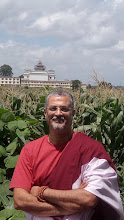
Girish Deshpande, is a Pune based Dharma practitioner
lamagirish@gmail.com
Saturday, May 22, 2010

An Empty Mind Need Not Be The Devils Workshop, Speaking Tree, 25/01/'10
MIND IT, AN EMPTY MIND IS THE BUDDHA’S PLAYFIELD:
It is strange how we have been made to believe since growing years, of a devil working in an empty mind! It is quite to the contrary. Allow me to explain, giving a Buddhist viewpoint.
To make it simpler to understand, as a ‘do it yourself’ experiment, try this in solitude. It will take only a few minutes.
Sit in any comfortable position (lotus position or just cross legged) in a quiet place, a garden or room, with the spine erect, hands folded across your lap, with the bottom of your right palm resting on the left palm and the two thumbs touching each other. Eyes angled at the slant of the nose, shoulders thrown back, chin slightly tucked in and the tongue tip touching the palate of the slightly open mouth. The 7-point Vairacona posture.
Steady the mind with slow & regular breaths. Focus on the breath till you sense reasonable steadiness of the mind. Observe the mind carefully of what is happening within it. Quite likely there will be thoughts within the mind, because such is the nature of mind. As we know, of all the forms, sounds, thoughts & perceptions there is nothing that does not arise in the mind. Now observe mindfully what is happening to these thoughts. Some come & go on their own, few others linger on and retreat while yet others are persistent. This too is a normal experience.
Here begins the interesting part.
While in this state of observance, where you are aware of what is going on around you but not engaging the goings on in any way, you will ‘see’ that unless there is an engagement of any arisen thought or feeling by the intervention of any one of the 6 senses, 5 sensory and the conceptualized mind, there is no response that will be forthcoming in the form of body or speech actions. This means that only when we engage, consciously or sub-consciously, our arising thoughts & feelings, do they have the capacity to manifest further. In corollary it means, if we do not engage arising thoughts or feelings, they will die or fade out on their own. This is the root nature of our mind. Awareness undivided from Emptiness. This is known as the View.
Slowly come out of this state and return to the ordinary state.
Here is how this experiment can be made to work for our benefit in routine life to increase happiness in us & those around us. As soon as an external negative stimulus of any kind is given to the mind, be it an angry word, an unpleasant smell, a loud sound, a painful feeling, a sorrowful sight, a negative thought arising out of jealousy, greed, desire or any such with a capacity to bring suffering upon us or others, observe for a moment how this stimulus is being treated by the mind before reacting to the stimulus. If we can effectively change this ‘immediately reactive’ treatment into a ‘delayed responsive’ kind of treatment from within the state of emptiness as explained above, the resultant offering will be pleasant & virtuous one.
How do we do this? Simple, if we train ourselves in mindfulness. At all times be vigilant of the manner in which the mind is processing every external stimulus. Remember, to an ordinary mind, stimuli can be sensational, arousing, disturbing & seductive. The mind is gullible and thoughts can deceive easily. But if we are observant of our mind at every moment, we will be able to easily grasp the ‘slipping’ mind and instead respond from the View state of awareness-emptiness.
To keep this realization of the View in mind at all times, un-distracted, would be Meditation, which can be made a continuous living experience. And to relentlessly practice the accumulations of the View & Meditation at all times, is our Action. Perfecting this state is Dzogchen practice, central to the Nyingma tradition of Buddhism.
Remember to humbly dedicate all pleasant sights - all pure actions of body, speech & mind, pure in intention & motivation - for the liberation of all beings. Actions themselves have no capacity to bring benefit unless dedicated. Such dedication, detached from pride, ambition & conceptualization alone will bring us happiness thru liberation from sufference.
The above practice is of great benefit, since it places us in a state of perpetual happiness, which is the purpose of every life. The devil will soon checkout of the empty mind. Therein will reside the Buddha!
Girish Deshpande
(The author is a practicing Nyingma Buddhist)
It is strange how we have been made to believe since growing years, of a devil working in an empty mind! It is quite to the contrary. Allow me to explain, giving a Buddhist viewpoint.
To make it simpler to understand, as a ‘do it yourself’ experiment, try this in solitude. It will take only a few minutes.
Sit in any comfortable position (lotus position or just cross legged) in a quiet place, a garden or room, with the spine erect, hands folded across your lap, with the bottom of your right palm resting on the left palm and the two thumbs touching each other. Eyes angled at the slant of the nose, shoulders thrown back, chin slightly tucked in and the tongue tip touching the palate of the slightly open mouth. The 7-point Vairacona posture.
Steady the mind with slow & regular breaths. Focus on the breath till you sense reasonable steadiness of the mind. Observe the mind carefully of what is happening within it. Quite likely there will be thoughts within the mind, because such is the nature of mind. As we know, of all the forms, sounds, thoughts & perceptions there is nothing that does not arise in the mind. Now observe mindfully what is happening to these thoughts. Some come & go on their own, few others linger on and retreat while yet others are persistent. This too is a normal experience.
Here begins the interesting part.
While in this state of observance, where you are aware of what is going on around you but not engaging the goings on in any way, you will ‘see’ that unless there is an engagement of any arisen thought or feeling by the intervention of any one of the 6 senses, 5 sensory and the conceptualized mind, there is no response that will be forthcoming in the form of body or speech actions. This means that only when we engage, consciously or sub-consciously, our arising thoughts & feelings, do they have the capacity to manifest further. In corollary it means, if we do not engage arising thoughts or feelings, they will die or fade out on their own. This is the root nature of our mind. Awareness undivided from Emptiness. This is known as the View.
Slowly come out of this state and return to the ordinary state.
Here is how this experiment can be made to work for our benefit in routine life to increase happiness in us & those around us. As soon as an external negative stimulus of any kind is given to the mind, be it an angry word, an unpleasant smell, a loud sound, a painful feeling, a sorrowful sight, a negative thought arising out of jealousy, greed, desire or any such with a capacity to bring suffering upon us or others, observe for a moment how this stimulus is being treated by the mind before reacting to the stimulus. If we can effectively change this ‘immediately reactive’ treatment into a ‘delayed responsive’ kind of treatment from within the state of emptiness as explained above, the resultant offering will be pleasant & virtuous one.
How do we do this? Simple, if we train ourselves in mindfulness. At all times be vigilant of the manner in which the mind is processing every external stimulus. Remember, to an ordinary mind, stimuli can be sensational, arousing, disturbing & seductive. The mind is gullible and thoughts can deceive easily. But if we are observant of our mind at every moment, we will be able to easily grasp the ‘slipping’ mind and instead respond from the View state of awareness-emptiness.
To keep this realization of the View in mind at all times, un-distracted, would be Meditation, which can be made a continuous living experience. And to relentlessly practice the accumulations of the View & Meditation at all times, is our Action. Perfecting this state is Dzogchen practice, central to the Nyingma tradition of Buddhism.
Remember to humbly dedicate all pleasant sights - all pure actions of body, speech & mind, pure in intention & motivation - for the liberation of all beings. Actions themselves have no capacity to bring benefit unless dedicated. Such dedication, detached from pride, ambition & conceptualization alone will bring us happiness thru liberation from sufference.
The above practice is of great benefit, since it places us in a state of perpetual happiness, which is the purpose of every life. The devil will soon checkout of the empty mind. Therein will reside the Buddha!
Girish Deshpande
(The author is a practicing Nyingma Buddhist)
Direct Your Actions for the Common Good, (Speaking Tree, 8/12/'09)
On many occasions we may have a feeling to perform a virtuous or meritorious act to instil ‘feel goodness’ within us. This is a noble thing to do and one can increase the benefits arising from such actions by being mindful of a few things.
Often when actions of such nature are performed they may arise out of a feeling of guilt washing, pride about good deeds, ambitions for this life etc. While such poison mixed feelings will bring no benefit at all, those which arise out of a pure mind, un-contrived, un-conditioned & un-conceptualized, the merits of such actions can be magnified.
Bear in mind that the actions by themselves have no direction of their own, no capacity to bring merit unless the action is dedicated from arising from source, towards a particular person/people and the goal of directing the dedication.
One day the Buddha was invited by the people of a town for a meal. Soon after they left 500 pretas (those born in hungry ghost realm) arrived and requested him to dedicate to them the merit of the alms the people would offer to the Buddha. On asking why the reason, the pretas said they were the parents of these residents and were reborn as pretas due to their miserly behaviour. The Buddha agreed on the condition that they accompany him. On seeing them the people were horrified. On the Buddha’s explanation & reassurance to them they calmed down. The Buddha made a request for dedicating their sources of merit to the pretas. The people agreed unanimously. The Buddha said:
May all the merit of this offering
Go to these pretas
May they be rid of their ugly bodies
And obtain the happiness of higher worlds!
No sooner, all the pretas died and the Buddha explained to the people that they were reborn in higher worlds.
Therefore, bear in mind that all actions should be from a pure mind and so arising be dedicated to bring benefit to those they are intended towards for any small reason. Be it the family’s well-being, parents’ good health, for the dead or to bring enlightenment for all sentient beings. Whatever be your meritorious action, small or big, if it is dedicated without conceptualization, i.e. be pure in intention & motivation, it will bring benefit to the people you have in mind. If not, it is like having wholesome food mixed with poison! Also bear in mind that all actions are illusory, by nature empty & magical. Therefore, have no attachment towards them only then that dedication would indeed be non-poisonous.
As Jetsun Mila (1040-1123), Tibet’s great yogi & poet says:
Between the hermit meditating in the mountain
And the donor who provides his sustenance
There is a link that will lead them to enlightenment together
Dedication of (pure) merit is the very heart of that link
Not just this. The benefits go further as Chagme Rinpoche says:
When we hear about (unconceptualized) good done by others,
If we cast out all negative thoughts of jealousy
And really rejoice in the depth of our hearts,
It is said that the merit we gain will be equal to theirs.
Such is the nature of feeling goodness towards pure actions.
Therefore, arise the bodhichitta (mind of special motivation) within yourself. Do merit worthy actions with purity. Dedicate the act to the end in view. Bear in mind that all of it is empty by nature, illusory and dream like. And revel in the goodness done by others.
Bliss then will reside within.
Girish Deshpande
(The author is a practicing Nyingma Buddhist)
Often when actions of such nature are performed they may arise out of a feeling of guilt washing, pride about good deeds, ambitions for this life etc. While such poison mixed feelings will bring no benefit at all, those which arise out of a pure mind, un-contrived, un-conditioned & un-conceptualized, the merits of such actions can be magnified.
Bear in mind that the actions by themselves have no direction of their own, no capacity to bring merit unless the action is dedicated from arising from source, towards a particular person/people and the goal of directing the dedication.
One day the Buddha was invited by the people of a town for a meal. Soon after they left 500 pretas (those born in hungry ghost realm) arrived and requested him to dedicate to them the merit of the alms the people would offer to the Buddha. On asking why the reason, the pretas said they were the parents of these residents and were reborn as pretas due to their miserly behaviour. The Buddha agreed on the condition that they accompany him. On seeing them the people were horrified. On the Buddha’s explanation & reassurance to them they calmed down. The Buddha made a request for dedicating their sources of merit to the pretas. The people agreed unanimously. The Buddha said:
May all the merit of this offering
Go to these pretas
May they be rid of their ugly bodies
And obtain the happiness of higher worlds!
No sooner, all the pretas died and the Buddha explained to the people that they were reborn in higher worlds.
Therefore, bear in mind that all actions should be from a pure mind and so arising be dedicated to bring benefit to those they are intended towards for any small reason. Be it the family’s well-being, parents’ good health, for the dead or to bring enlightenment for all sentient beings. Whatever be your meritorious action, small or big, if it is dedicated without conceptualization, i.e. be pure in intention & motivation, it will bring benefit to the people you have in mind. If not, it is like having wholesome food mixed with poison! Also bear in mind that all actions are illusory, by nature empty & magical. Therefore, have no attachment towards them only then that dedication would indeed be non-poisonous.
As Jetsun Mila (1040-1123), Tibet’s great yogi & poet says:
Between the hermit meditating in the mountain
And the donor who provides his sustenance
There is a link that will lead them to enlightenment together
Dedication of (pure) merit is the very heart of that link
Not just this. The benefits go further as Chagme Rinpoche says:
When we hear about (unconceptualized) good done by others,
If we cast out all negative thoughts of jealousy
And really rejoice in the depth of our hearts,
It is said that the merit we gain will be equal to theirs.
Such is the nature of feeling goodness towards pure actions.
Therefore, arise the bodhichitta (mind of special motivation) within yourself. Do merit worthy actions with purity. Dedicate the act to the end in view. Bear in mind that all of it is empty by nature, illusory and dream like. And revel in the goodness done by others.
Bliss then will reside within.
Girish Deshpande
(The author is a practicing Nyingma Buddhist)
The Three Nobilities (Speaking Tree, 19/04/'10)
THE THREE NOBILITIES – Prelude to Mantra Recitation
When you chant and recite any mantra, you must bear in mind the importance of the Three Nobilities: Bodhichitta, Non-Objectifying Wisdom and Dedication. This brings benefit to the one reciting and for those it is meant to bring benefit.
There are two things to be borne in mind alongwith this: Firstly, to keep secret of your mantra recitation and its result. Secondly, one must also be mindful not to speak others who are not Dharma practitioners about one's practice and accrued benefit. If we are not mindful of this, the result will not be perfect due to many forces that may be counter active.
These three nobilities are as important as your yearning to achieve the result at the end by reciting the specific mantra.
The 1st nobility is called Bodhichitta, which is ‘Awakened Mind’ and means generation of a special motivation to benefit all sentient beings with the virtues being accumulated. So this motivation should be generated prior to any kind of virtuous practice. You can read this line to motivate yourself for the benefit of others: "I will benefit all sentient beings bestowing them with the Eternal Bliss and Qualities."
The 2nd nobility is called Non-Objectifying Wisdom, which means whatever virtue is accumulated or practiced, it's practiced without any sense of clinging desires in the mind. This, in other term, called primordial awareness is maintained during the main practice itself. One should be fully aware without any clinging or self-centric desires such as, ‘I am the one who practices this virtue’ or ‘this is the virtue I'm practicing and for them I practice’ and so on. In fact, one should cut through such kinds of thoughts from one's mind stream. So when the mind is devoid of such discriminative thoughts, all emotions naturally calm down. It is therefore called Non-Objectifying Wisdom, the true and primordial awareness of all beings.
The 3rd nobility is called Dedication, which means whatever virtue has been accumulated, for example here by chanting and reciting the mantra, it is dedicated for the benefit of sentient beings to rid them of their suffering and bringing them happiness. Probably, the dedication prayer is chanted only after the virtuous practice. Chant this line as a dedication prayer: "Gewa Ma-ghen Drodug Kunla Ngo – which means “May all motherly sentient beings attain enlightenment through the power of my virtues that I have accumulated by chanting and reciting the mantra."
It is of crucial importance to feel what other beings need. Feel what you need. To our surprise we will find out that the need and requirement is one and same, that is happiness. Each and every being needs nothing more than happiness. So it is with us. Therefore all sentient beings are similar and even same. However, remember that just like us, other sentient beings too get trapped in the net of sufferings, pains, torture, afflictions, emotions and so on. Now feel and chant this: “May all sentient beings be free from sufferings and its causes.” This is the real definition of compassion.
Extend this practice further from one being to two and four – that’s from your family then to neighbourhood to town to cities to country and further towards all sentient beings.
Practice this daily and see the results. Remember, the Dharma belongs to nobody. It is his/hers who endeavours most.
Girish Deshpande – The author is a practitioner of Nyingma Buddhism
When you chant and recite any mantra, you must bear in mind the importance of the Three Nobilities: Bodhichitta, Non-Objectifying Wisdom and Dedication. This brings benefit to the one reciting and for those it is meant to bring benefit.
There are two things to be borne in mind alongwith this: Firstly, to keep secret of your mantra recitation and its result. Secondly, one must also be mindful not to speak others who are not Dharma practitioners about one's practice and accrued benefit. If we are not mindful of this, the result will not be perfect due to many forces that may be counter active.
These three nobilities are as important as your yearning to achieve the result at the end by reciting the specific mantra.
The 1st nobility is called Bodhichitta, which is ‘Awakened Mind’ and means generation of a special motivation to benefit all sentient beings with the virtues being accumulated. So this motivation should be generated prior to any kind of virtuous practice. You can read this line to motivate yourself for the benefit of others: "I will benefit all sentient beings bestowing them with the Eternal Bliss and Qualities."
The 2nd nobility is called Non-Objectifying Wisdom, which means whatever virtue is accumulated or practiced, it's practiced without any sense of clinging desires in the mind. This, in other term, called primordial awareness is maintained during the main practice itself. One should be fully aware without any clinging or self-centric desires such as, ‘I am the one who practices this virtue’ or ‘this is the virtue I'm practicing and for them I practice’ and so on. In fact, one should cut through such kinds of thoughts from one's mind stream. So when the mind is devoid of such discriminative thoughts, all emotions naturally calm down. It is therefore called Non-Objectifying Wisdom, the true and primordial awareness of all beings.
The 3rd nobility is called Dedication, which means whatever virtue has been accumulated, for example here by chanting and reciting the mantra, it is dedicated for the benefit of sentient beings to rid them of their suffering and bringing them happiness. Probably, the dedication prayer is chanted only after the virtuous practice. Chant this line as a dedication prayer: "Gewa Ma-ghen Drodug Kunla Ngo – which means “May all motherly sentient beings attain enlightenment through the power of my virtues that I have accumulated by chanting and reciting the mantra."
It is of crucial importance to feel what other beings need. Feel what you need. To our surprise we will find out that the need and requirement is one and same, that is happiness. Each and every being needs nothing more than happiness. So it is with us. Therefore all sentient beings are similar and even same. However, remember that just like us, other sentient beings too get trapped in the net of sufferings, pains, torture, afflictions, emotions and so on. Now feel and chant this: “May all sentient beings be free from sufferings and its causes.” This is the real definition of compassion.
Extend this practice further from one being to two and four – that’s from your family then to neighbourhood to town to cities to country and further towards all sentient beings.
Practice this daily and see the results. Remember, the Dharma belongs to nobody. It is his/hers who endeavours most.
Girish Deshpande – The author is a practitioner of Nyingma Buddhism
Sky Nature of Mind ( Speaking Tree , 5th May 2010)
CLOUDS AND THE SKY – Mind v/s The Mind
In every sentient being the buddha mind is omnipresent. We don’t have to go looking for it. We don’t have to do strive to perfect it. It has been with us ever since birth and it is always perfect! Just as the sky. This is the nature of our mind. Who would want to strive to perfect a cloudless sky?
It is a foregone conclusion that all beings want happiness and not suffering. Besides the four natural sufferings of birth, sickness, old age & death, right from the smallest insect to human beings all of us want to be happy at all other times. So why do our actions of body, speech & mind work often in contradiction to what we really want and end up bringing suffering to us? The reason is simple. Because we allow them to. Is there a way we can correct this way of working of the mind? Yes, there certainly is, only if we attempt to clear the clouds that cover the beautiful sky.
Now, if we already have the problem identified - that of exploring the spontaneously present, perfect, sky-like brilliance of the mind - what holds us back from finding solutions to it? The teachings in Buddhism speak of them as the Four Faults. Lets explore them briefly.
1. Being too Close: Have you ever tried to see your face without the help of a reflection? It’s not possible. In the same manner, masters say that the nature of the mind is so close to our mind that it finds it difficult to see it.
2. Being too Profound: How often have you waded into unknown waters? You take a few steps and the fear of the unknown stops you. In a similar manner, we have no idea how deep the nature of mind would be. We cannot fathom its depth. So we don’t make an attempt. If we knew how deep or profound it is, we would have made atleast some attempt to gauge it.
3. Being too Easy: It is often that we have not attempted something simply because it was too easy. So it is with the nature of mind. Something that has always been with us, always perfect, gets a priority that is low amongst other worldly distractions & attractions.
4. Being too Wonderous: How many times we have left something untried because we see the immensity of the task? So it is with our conceptualized, narrow, small & contrived minds. We just don’t believe that we can actually attain enlightenment which is the base or root nature of our minds.
These faults were contemplated hundreds of years ago in Tibet. A nation then, and perhaps even now, dedicated in pursuit of enlightenment. If this was relevant to a civilization of that kind, imagine how relevant it is in the modern world of sheer materialism and confusion.
The sadness is that there are not too many things expressed about this naked, virgin state of our mind. Scientific pursuits & discoveries that drive global thinking don’t even believe something like the base mind exists. They speak of the mind as the intellectual mind of thoughts, skills & emotions. The fact is that intellectual mind cannot understand the primordial mind as it exists in the relative plane while the other on an absolute plane. Yet, there are occasions when unknowingly we have experienced a fleeting glimpse of the presence of such perfect state of mind. Say, while watching a scintillating ballet performance or whilst listening to a perfect rendition of a raga, or when amidst nature in total silence and other similar pristine moments.
So if this state actually exists, what can we do to observe and experience it more often, if not stay in such a state at all times? Look inward.
During the course of my training, i was astonished to learn that the Tibetan word for ‘Buddhist’ is nangpa, which means “inside-er”! To seek the lessons of living & dying not from the sources outside but by peeping into the nature of our own mind. Alas, in today’s times we have been driven to habituating ourselves to seek answers outside, thereby enslaving ourselves further. All this, under the false garb we foolishly call freedom. How contradictory! People fear to look within themselves, not knowing what they will find. Whether they will be able to face what they will find. They are afraid that they will be treated like social outcasts amongst friends, like mad people, left alone to live life in solitude. And this conceptualized, misplaced approach plays perfectly into the ploy of the wily ego, who could have asked for nothing more!
The truth is that the answers you genuinely seek will come to you only from within the nature of your mind and not the nurtured mind. Even if you get the most accomplished teacher, his/her only responsibility will be to guide you through the unknown pathways with the help of teachings and practices, cutting thru the obscurations of the contrived mind and make you discover the true nature of your mind. And in doing so, help you dispel the fears of sickness, old age & death and understand better the prospect of life, death and after life.
Endeavour on, dear friends! Let the winds of awakening blow away the clouds from the sky nature of your mind. Introduce yourself to the perfect sky that is your very own and has always been with you. This is the only happy way out from here! Buddhahood to you.
Girish Deshpande
(The author is a Pune based Dharma practitioner)
In every sentient being the buddha mind is omnipresent. We don’t have to go looking for it. We don’t have to do strive to perfect it. It has been with us ever since birth and it is always perfect! Just as the sky. This is the nature of our mind. Who would want to strive to perfect a cloudless sky?
It is a foregone conclusion that all beings want happiness and not suffering. Besides the four natural sufferings of birth, sickness, old age & death, right from the smallest insect to human beings all of us want to be happy at all other times. So why do our actions of body, speech & mind work often in contradiction to what we really want and end up bringing suffering to us? The reason is simple. Because we allow them to. Is there a way we can correct this way of working of the mind? Yes, there certainly is, only if we attempt to clear the clouds that cover the beautiful sky.
Now, if we already have the problem identified - that of exploring the spontaneously present, perfect, sky-like brilliance of the mind - what holds us back from finding solutions to it? The teachings in Buddhism speak of them as the Four Faults. Lets explore them briefly.
1. Being too Close: Have you ever tried to see your face without the help of a reflection? It’s not possible. In the same manner, masters say that the nature of the mind is so close to our mind that it finds it difficult to see it.
2. Being too Profound: How often have you waded into unknown waters? You take a few steps and the fear of the unknown stops you. In a similar manner, we have no idea how deep the nature of mind would be. We cannot fathom its depth. So we don’t make an attempt. If we knew how deep or profound it is, we would have made atleast some attempt to gauge it.
3. Being too Easy: It is often that we have not attempted something simply because it was too easy. So it is with the nature of mind. Something that has always been with us, always perfect, gets a priority that is low amongst other worldly distractions & attractions.
4. Being too Wonderous: How many times we have left something untried because we see the immensity of the task? So it is with our conceptualized, narrow, small & contrived minds. We just don’t believe that we can actually attain enlightenment which is the base or root nature of our minds.
These faults were contemplated hundreds of years ago in Tibet. A nation then, and perhaps even now, dedicated in pursuit of enlightenment. If this was relevant to a civilization of that kind, imagine how relevant it is in the modern world of sheer materialism and confusion.
The sadness is that there are not too many things expressed about this naked, virgin state of our mind. Scientific pursuits & discoveries that drive global thinking don’t even believe something like the base mind exists. They speak of the mind as the intellectual mind of thoughts, skills & emotions. The fact is that intellectual mind cannot understand the primordial mind as it exists in the relative plane while the other on an absolute plane. Yet, there are occasions when unknowingly we have experienced a fleeting glimpse of the presence of such perfect state of mind. Say, while watching a scintillating ballet performance or whilst listening to a perfect rendition of a raga, or when amidst nature in total silence and other similar pristine moments.
So if this state actually exists, what can we do to observe and experience it more often, if not stay in such a state at all times? Look inward.
During the course of my training, i was astonished to learn that the Tibetan word for ‘Buddhist’ is nangpa, which means “inside-er”! To seek the lessons of living & dying not from the sources outside but by peeping into the nature of our own mind. Alas, in today’s times we have been driven to habituating ourselves to seek answers outside, thereby enslaving ourselves further. All this, under the false garb we foolishly call freedom. How contradictory! People fear to look within themselves, not knowing what they will find. Whether they will be able to face what they will find. They are afraid that they will be treated like social outcasts amongst friends, like mad people, left alone to live life in solitude. And this conceptualized, misplaced approach plays perfectly into the ploy of the wily ego, who could have asked for nothing more!
The truth is that the answers you genuinely seek will come to you only from within the nature of your mind and not the nurtured mind. Even if you get the most accomplished teacher, his/her only responsibility will be to guide you through the unknown pathways with the help of teachings and practices, cutting thru the obscurations of the contrived mind and make you discover the true nature of your mind. And in doing so, help you dispel the fears of sickness, old age & death and understand better the prospect of life, death and after life.
Endeavour on, dear friends! Let the winds of awakening blow away the clouds from the sky nature of your mind. Introduce yourself to the perfect sky that is your very own and has always been with you. This is the only happy way out from here! Buddhahood to you.
Girish Deshpande
(The author is a Pune based Dharma practitioner)
Monday, November 16, 2009
WALKING WITH THE BUDDHA, (Speaking Tree Paper, 11/04/'10)
.JPG)
- Travelogue Of An Urban Seeker.
Violent thoughts had been storming the mind for too long now and there was no other way for a settlement but a sabbatical. For a few years now i had sensed that at a time when emotions were panning the globe like never before, there must be a lasting way to sort out imbalances of the within and without. To empower oneself to justify, seek and perhaps redefine man’s relation with man and that with himself, rather than with his god. There were breaks that i had taken in the past too, to try and iron these out thru trial but they had at best been seriously flirting attempts and therefore limited in wholesome benefit. This time, as i was to realize later, would be life altering, making a committed attempt by treading the Way of Awakening in the footsteps of the Buddha.
Few months earlier to the plan, i sought permission from the wife of 20yrs. With the first go-bye signalled, i now turned to my young spiritual friend of 2years. Chogyal Wangdi, a Lopon by designation thru 17yrs of merit-worthy practice, has a Masters in Philosophy from the Nyingma University of Tibetan Buddhism, Karnataka. It was from him that i picked up the nuances of the tradition during my two week stint at Bylakuppe, a couple of years ago. He was delighted to know of my interest in travelling to Bodh Gaya, the very heart of enlightenment. Over the years, Chogyal, a Bhutanese, at 35 a decade younger to me in age, has been a beacon of guidance, a living Buddha for me. Encouraging in every way, compassionate, providing meanings and relevant information patiently, assisting whole-heartedly, answering every query mindfully he has been wisely and skilfully supportive all along. Whilst embarking on this sojourn, it was no different. Therefore, although not alone, yet now i was in solitude.
As the train chugged into Gaya station on a balmy October morn, it was well before daybreak. 3.45am. Suddenly the otherwise sleepy station came alive with the cacophony of autowallas, competing in fare & decibel, offering to take me and my faithful rucksack, to Bodh Gaya, a hours drive away. The bumpy ride tumbled thru an ocean of darkness towards the shore of enlightenment with the noisy chatter of diesel engine and pitter-patter of a light drizzle, for re-assuring company.
Bodh Gaya, 120kms that takes 5hrs from dusty Patna, today a small town in Bihar, no more than 5sqkm, is the very place where Prince Siddhartha Gautama of the Sakya clan was transformed into Sakyamuni Buddha, meditating un-distracted for forty-nine moons, amidst what once was dense forest. The leafy premises of the well-planned Mahabodhi temple inspire nothing else but peace & serenity, infusing the right energies the seeker aspires. Although many locals follow other faiths, there is no doubt that central to Bodh Gaya, is Buddhism.
It was still before daybreak when I arrived at the Bhutan Monastery which was to be my home over the next two weeks. Like most urban night watchmen, this one was asleep too. I was reasonably sure he would have gone back to bed once he had opened one of the rooms i had managed to book ahead, since he said “Ab aap bhi so jao…subah baat karenge”. The journey had begun.
Except for the outside of the main temple area, where once witnesses unfortunate sights of karmic suffering, each day the sprawling, carefully manicured, warmly inviting, well shaded, immaculately clean, Mahabodhi temple premise comes alive at 4am. Central to all the ‘action’ is the Bodhi Tree, the fourth generation of the original under which Enlightenment was attained just before daybreak by the Supreme Master. Monks, bhikkus, bhikkunis, lamas, practicing laity, believers, tourists from all over the world, South East Asia in particular, converge here for reasons of prayer, altruistic ceremony, meditation, chanting, seeking, understanding, redeeming, confessing, reading, prostrating, offering & receiving alms with utmost respect & dignity, all co-habiting in a state of heightened awareness and harmony as part of the community, called Sangha. Alongside, playful squirrel, chatty birds, friendly campus dogs and other sentient beings feel included too.
Chogyal had kindly arranged for me to meet with two teachers in his friends, both Lopons, Sonam Phurbu and Tenzin Dorjee, both also practitioners of the Nyingma tradition. Well, it kind of worked well since each one knew one language well! Doubts along the Way were addressed by them with alacrity in Hindi & English.
The ensuing days had an intensely definitive pattern. Praying, Meditating, Reading, Practicing, Seeking. Praying, Meditating, Reading, Practicing, Seeking some more…and was i in bliss? The Buddha Dharma is as exciting as it is exacting a finger that points towards cessation of suffering. It is his who endeavours most, advised the famed Sakya monk.
By now i had decided to take refuge in the (root) Teacher, the Buddha, the Dharma and the Sangha. It is the refuge that makes the difference between a Buddhist and a non-Buddhist, i was told. "Is there an obligation to follow ones parents’ faith?" crossed a thought. And i was at peace with the answer. So, also were taken the Bodhichitta vows, the Guru Yoga vows, the Purification vows, Empowerments and other necessities. The turmoil within was all of a sudden secured with unparalleled happiness. Unimaginable joy permeated within. The mind emptied and cleared. The Buddha smiled.
I have since changed faith. I am now a Nyingma Buddhist.
‘Nyingma’ means ‘old’ or ‘ancient’, and has its roots in Tibet, introduced by Guru Rinpoche (Padmasambhava or Lotus Born, 8th CE), the Second Buddha. ‘Dzogchen’ or Great Perfection teachings are central to the Nyingma tradition.
As forces of the universe conspired to further my journey despite blown-up railway tracks, i was able to travel further into Sikkim. At Gangtok, it was to seek blessings of HH Dodrup Rinpoche at Chorten Gompa. Leaving the hustle & bustle of Gangtok, i headed for the hills. With Mt. Kanchendzonga and her lovely little sisters in the peaks of Kabru, Simvo, Pandim, Narsing as formidable companions, it was unabated seeking opportunities at the heritage monasteries of Pemayangtse and Sanga Choeling, both of the Nyingma sect.
The commanding views of these mountains around me were mesmeric. Sample this: To wake up on Diwali day and realize the meaning of ‘festival of lights’ to be the silent golden glow of the first rays of the sun bounce off the lording massiff! Isn’t this what some called nirvana? Incidentally, there are plenty of delightful walks & hikes from here to suit every interest level. Some offer inspiring views of the mountains upclose.
In co-existing tranquillity, my mind and i moved further into the hills on a plateau near the sacred lake Kechoperi. And as divine intervention would have it, i was able to meet with a senior lama whose family ran a rudimentary homestay. So fondly Pala lama took to me that he offered his prayer cottage for the days i spent there. With Pala, all of energetic 83yrs, few more days of intense practice followed.
On the travel back, it was crucial to gain insight into integrating the practices with turbulent urban life, making living & dying seamless experiences, in equanimity, with proper realization of the Way.
There are times in one’s life when dependant co-arising forces converge to fulfil our justified, virtuous and higher aspirations. This was it for me. I finally found myself walking with the Buddha. And i hope to keep pace, gently and mindfully.
Wednesday, November 4, 2009
Back from sabattical...

greetings to all!
I'm back from the 4 week sabattical. It was gainful as i have returned less confused in worldly ways. :-)
10 days at bodh gaya were extremely enriching. The place (Mahabodhi temple) and the surroundings around it are incredibly beautiful & peaceful. Ofcourse, at the entrance one sees the usual sights of unfortunate people in suffering due to poverty, hunger, sickness on a/c ripening karma. Once inside the large, well -planned, very clean & leafy premises are energizing yet tranquilizing.
Days usually began at 4am and closed 7pm with mind comprehension practices, learning and reading, under guidance from senior monks. Stayed at the Bhutan monastery.
Thereafter Sikkim it was which began at gangtok with the blessings from HH Dodrupchen Rinpoche, a highly regarded & very senior lama. I then wormed my way for another week into some parts of west & south west Sikkim with the fabulous Kanchendzonga range as companion all thruout...and again practicing with a senior lama. The festival of lights for me this year was to see Mt. Kanchendzonga & her lovely little sisters being lit up by the first surge of early morning sunrays! enthralling. (see pic)
During this sabattical, i have taken refuge vows, ground & path empowerments & purification vows amongst other necessities, and am now a practicing nyingma buddhist. of the 6 sects, nyingma, meaning 'ancient' or 'old' is the oldest and follows the tantryana-vajrayana lineage of Tibetan Buddhism.
All for now. Will try & post some pics. hope you all had a splendid diwali with family. ( Please Read: Walking with the Buddha, Speaking Tree, that carried a full-page on this wonderous journey!)
Subscribe to:
Posts (Atom)